
Design tools support architecture documentation, API specification, data modeling, and system visualization. This guide covers tools for each aspect of software design.
Architecture Diagramming
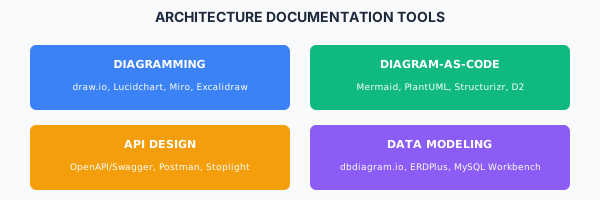
Diagramming Tools
Visual Editors
| Tool | Type | Best For |
|---|---|---|
| draw.io (diagrams.net) | Free | General diagramming, integrations |
| Lucidchart | Commercial | Team collaboration |
| Miro | Whiteboard | Brainstorming, workshops |
| Excalidraw | Free | Hand-drawn style diagrams |
| Figma | Design | UI/UX, interactive prototypes |
| Whimsical | Commercial | Flowcharts, wireframes |
Diagram-as-Code Tools
| Tool | Language | Use Case |
|---|---|---|
| Mermaid | Markdown-like | Documentation, Git-friendly |
| PlantUML | Text-based | UML diagrams |
| Structurizr | DSL | C4 model diagrams |
| D2 | Text-based | Modern declarative diagrams |
| Graphviz | DOT | Graph visualization |
C4 Model Tools
The C4 model provides a hierarchical approach to software architecture documentation.
Structurizr DSL Example
workspace {
    model {
        user = person "User" "A user of the system"

        softwareSystem = softwareSystem "My System" {
            webapp = container "Web Application" "React frontend" "TypeScript"
            api = container "API" "REST API" "Node.js"
            database = container "Database" "PostgreSQL" "PostgreSQL 15"
        }

        user -> webapp "Uses"
        webapp -> api "Makes API calls to" "HTTPS/JSON"
        api -> database "Reads from and writes to" "SQL/TCP"
    }

    views {
        systemContext softwareSystem {
            include *
            autolayout lr
        }

        container softwareSystem {
            include *
            autolayout lr
        }

        theme default
    }
}
Mermaid C4 Diagram
C4Context
    title System Context diagram for My System

    Person(user, "User", "A user of the system")
    System(system, "My System", "The main system")
    System_Ext(email, "Email System", "Sends emails")
    System_Ext(payment, "Payment Provider", "Handles payments")

    Rel(user, system, "Uses")
    Rel(system, email, "Sends emails using")
    Rel(system, payment, "Processes payments via")
API Design Tools
OpenAPI/Swagger
| Tool | Type | Features |
|---|---|---|
| Swagger Editor | Editor | Visual OpenAPI editing |
| Stoplight Studio | Editor | Visual API design |
| Postman | Platform | API design and testing |
| Insomnia | Client | API design and debugging |
| Redocly | Documentation | API documentation generator |
OpenAPI Specification Example
openapi: 3.1.0
info:
  title: User API
  version: 1.0.0
  description: API for managing users

servers:
  - url: https://api.example.com/v1
    description: Production server

paths:
  /users:
    get:
      summary: List all users
      operationId: listUsers
      parameters:
        - name: limit
          in: query
          schema:
            type: integer
            default: 20
            maximum: 100
        - name: offset
          in: query
          schema:
            type: integer
            default: 0
      responses:
        '200':
          description: A list of users
          content:
            application/json:
              schema:
                type: object
                properties:
                  data:
                    type: array
                    items:
                      $ref: '#/components/schemas/User'
                  pagination:
                    $ref: '#/components/schemas/Pagination'

    post:
      summary: Create a user
      operationId: createUser
      requestBody:
        required: true
        content:
          application/json:
            schema:
              $ref: '#/components/schemas/CreateUserRequest'
      responses:
        '201':
          description: User created
          content:
            application/json:
              schema:
                $ref: '#/components/schemas/User'

components:
  schemas:
    User:
      type: object
      properties:
        id:
          type: string
          format: uuid
        email:
          type: string
          format: email
        name:
          type: string
        createdAt:
          type: string
          format: date-time
      required:
        - id
        - email
        - name

    CreateUserRequest:
      type: object
      properties:
        email:
          type: string
          format: email
        name:
          type: string
        password:
          type: string
          minLength: 8
      required:
        - email
        - name
        - password

    Pagination:
      type: object
      properties:
        total:
          type: integer
        limit:
          type: integer
        offset:
          type: integer
Data Modeling Tools
Database Design Tools
| Tool | Type | Features |
|---|---|---|
| dbdiagram.io | Web | Text-based ERD, export SQL |
| ERDPlus | Web | Free ERD design |
| MySQL Workbench | Desktop | MySQL design and admin |
| pgAdmin | Desktop | PostgreSQL admin |
| DBeaver | Desktop | Universal database tool |
| DataGrip | Desktop | JetBrains database IDE |
dbdiagram.io Example
// Use DBML to define your database structure

Table users {
  id uuid [pk]
  email varchar [unique, not null]
  name varchar [not null]
  password_hash varchar [not null]
  created_at timestamp [default: `now()`]
  updated_at timestamp

  indexes {
    email [unique]
  }
}

Table organizations {
  id uuid [pk]
  name varchar [not null]
  slug varchar [unique, not null]
  created_at timestamp [default: `now()`]
}

Table memberships {
  id uuid [pk]
  user_id uuid [ref: > users.id]
  organization_id uuid [ref: > organizations.id]
  role varchar [not null, default: 'member']
  created_at timestamp [default: `now()`]

  indexes {
    (user_id, organization_id) [unique]
  }
}

Table projects {
  id uuid [pk]
  organization_id uuid [ref: > organizations.id]
  name varchar [not null]
  description text
  status varchar [default: 'active']
  created_at timestamp [default: `now()`]
}
UML Modeling
PlantUML Examples
@startuml
' Class Diagram
class User {
  - id: UUID
  - email: String
  - name: String
  + getFullName(): String
  + updateProfile(data: ProfileData): void
}

class Organization {
  - id: UUID
  - name: String
  - slug: String
  + addMember(user: User, role: Role): Membership
}

class Membership {
  - id: UUID
  - role: Role
  + promote(newRole: Role): void
}

User "1" -- "*" Membership
Organization "1" -- "*" Membership
@enduml
@startuml
' Sequence Diagram
actor User
participant "Web App" as Web
participant "API" as API
participant "Database" as DB
participant "Cache" as Cache
User -> Web: Login request
Web -> API: POST /auth/login
API -> DB: Validate credentials
DB --> API: User data
API -> Cache: Store session
Cache --> API: Session ID
API --> Web: JWT token
Web --> User: Redirect to dashboard
@endumlPrototyping Tools
UI/UX Design
| Tool | Type | Best For |
|---|---|---|
| Figma | Collaborative | Team design, prototyping |
| Sketch | macOS | UI design |
| Adobe XD | Adobe | Adobe ecosystem |
| Framer | Web | Interactive prototypes |
| Balsamiq | Wireframes | Low-fidelity wireframes |
Customer Journey Mapping
| Tool | Features |
|---|---|
| Miro | Collaborative whiteboard |
| FigJam | Figma's whiteboard |
| Smaply | Journey map templates |
| UXPressia | Journey mapping platform |
Documentation Tools
Technical Documentation
| Tool | Type | Features |
|---|---|---|
| Notion | Wiki | Collaborative documentation |
| Confluence | Wiki | Atlassian ecosystem |
| GitBook | Docs | Git-based documentation |
| Docusaurus | Static Site | React-based docs |
| MkDocs | Static Site | Python-based docs |
| Fumadocs | Static Site | Next.js docs framework |
Architecture Decision Records (ADRs)
# ADR-001: Use PostgreSQL as Primary Database

## Status
Accepted

## Context
We need to select a primary database for the application.
Requirements include:
- ACID compliance for financial transactions
- JSON support for flexible schemas
- Strong community and tooling support

## Decision
We will use PostgreSQL 15 as our primary database.

## Consequences
### Positive
- Excellent JSON/JSONB support
- Strong ACID compliance
- Mature ecosystem with excellent tooling
- Cost-effective (open source)

### Negative
- Team needs to upskill on PostgreSQL-specific features
- Horizontal scaling requires additional tooling (Citus, etc.)

## Alternatives Considered
- MySQL: Less JSON support
- MongoDB: Not ACID-compliant by default
- CockroachDB: Higher operational complexity
Integration Patterns
Diagram-as-Code in Documentation
# Architecture Overview

The system follows a microservices architecture:
graph TB subgraph "Frontend" A[React App] end
subgraph "API Gateway" B[Kong Gateway] end
subgraph "Services" C[User Service] D[Order Service] E[Payment Service] end
subgraph "Data" F[(PostgreSQL)] G[(Redis)] H[(Kafka)] end
A --> B B --> C B --> D B --> E C --> F D --> F E --> H C --> G
Related Resources
- Design - Design practices and patterns
- Architecture Templates - ADR templates
- API Design - API guidelines
- Code Reviews - Design review process
Compliance
This section fulfills ISO 13485 requirements for design and development planning (7.3.2), design outputs (7.3.4), and design documentation (4.2.3), and ISO 27001 requirements for secure architecture (A.8.27), secure development (A.8.25), and documented operating procedures (A.5.37).