
Case studies demonstrate how NUP has been applied in real-world projects across different industries and domains. These examples provide practical insights into implementing NUP practices effectively.
Identity and Access Management (IAM) Case Study
Context
| Attribute | Value |
|---|---|
| Industry | Healthcare |
| Project Type | Identity Management System |
| Team Size | 12 members |
| Duration | 18 months |
| Compliance | HIPAA, SOC 2 |
Challenge
A healthcare organization needed to implement a comprehensive Identity and Access Management (IAM) solution that would:
- Centralize user authentication across 15+ applications
- Support role-based access control (RBAC) for 5,000+ users
- Meet HIPAA compliance requirements for audit logging
- Integrate with existing Active Directory infrastructure
- Support MFA for all clinical applications
NUP Application
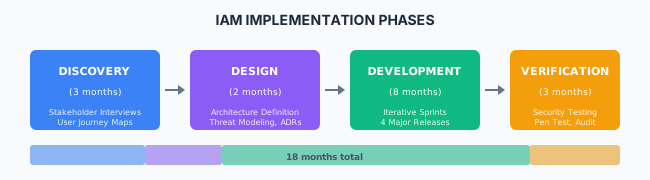
Discovery Phase
Activities:
- Conducted 25+ stakeholder interviews
- Mapped customer journeys for 6 user personas
- Documented 150+ functional requirements
- Performed compliance gap analysis
Key Artifacts:
- Vision Document
- Requirements Specification
- User Journey Maps
- Risk Assessment
Design Phase
Activities:
- Created architecture decision records (ADRs) for 12 major decisions
- Developed threat model using STRIDE methodology
- Designed RBAC permission model
- Specified integration patterns
Architecture Decisions:
| Decision | Choice | Rationale |
|---|---|---|
| Identity Provider | Okta | HIPAA-compliant, enterprise features |
| MFA Method | TOTP + Push | Balance of security and usability |
| Session Management | JWT + Redis | Stateless with revocation capability |
| Audit Logging | Splunk | Existing infrastructure, compliance |
Development Phase
Sprint Structure:
- 2-week sprints
- 16 sprints total
- 4 major releases (quarterly)
Release Summary:
| Release | Focus | Features |
|---|---|---|
| R1 | Foundation | Core authentication, AD sync |
| R2 | RBAC | Role management, permissions |
| R3 | MFA | TOTP, push notifications |
| R4 | Audit | Logging, compliance reports |
Verification Phase
Testing Activities:
- 95% unit test coverage
- 200+ integration tests
- Third-party penetration testing
- HIPAA compliance audit
Results
| Metric | Target | Achieved |
|---|---|---|
| Authentication Latency | < 500ms | 120ms avg |
| System Availability | 99.9% | 99.95% |
| MFA Adoption | 100% | 100% |
| Security Incidents | 0 critical | 0 critical |
| Compliance Audit | Pass | Pass |
Lessons Learned
What Worked Well
- Early Threat Modeling - Identifying security concerns in design phase prevented costly rework
- Iterative Releases - Quarterly releases allowed for user feedback incorporation
- Comprehensive Testing - High test coverage caught integration issues early
- Stakeholder Engagement - Regular demos maintained stakeholder buy-in
What We'd Do Differently
- Start MFA Testing Earlier - User acceptance of MFA required more iteration
- More Automated Compliance Checks - Manual compliance verification was time-consuming
- Earlier Performance Testing - Load testing in later stages found scaling issues
Healthcare Patient Portal Case Study
Context
| Attribute | Value |
|---|---|
| Industry | Healthcare |
| Project Type | Patient Portal |
| Team Size | 8 members |
| Duration | 12 months |
| Compliance | HIPAA, 508 Accessibility |
Challenge
A healthcare provider needed to build a patient portal that would:
- Allow patients to view medical records
- Enable secure messaging with providers
- Support appointment scheduling
- Meet HIPAA and Section 508 requirements
- Integrate with existing EHR system
NUP Application
Discovery Phase Artifacts
User Personas:
| Persona | Description | Key Needs |
|---|---|---|
| Active Patient | Tech-savvy, manages own health | Self-service, mobile access |
| Elderly Patient | Limited tech experience | Simple interface, large text |
| Caregiver | Manages family member's health | Proxy access, notifications |
Requirements Categories:
Functional Requirements: 85
- Authentication: 12
- Medical Records: 18
- Messaging: 15
- Scheduling: 20
- Notifications: 10
- Reports: 10

Non-Functional Requirements: 35
- Performance: 8
- Security: 12
- Accessibility: 10
- Availability: 5
Design Decisions
| Decision | Choice | Rationale |
|---|---|---|
| Frontend | React + TypeScript | Team expertise, accessibility libraries |
| Backend | Node.js + Express | Fast development, JSON APIs |
| Database | PostgreSQL | HIPAA-ready, strong data integrity |
| Integration | HL7 FHIR | Healthcare standard |
| Hosting | AWS GovCloud | HIPAA compliance |
Testing Strategy
| Test Type | Coverage | Tools |
|---|---|---|
| Unit Tests | 90% | Jest |
| Integration | 75% | Cypress |
| Accessibility | WCAG 2.1 AA | axe-core, WAVE |
| Security | OWASP Top 10 | OWASP ZAP |
| Performance | 1000 concurrent | k6 |
Results
- Launch: On-time delivery within 12-month timeline
- Adoption: 40% patient adoption within 6 months
- Satisfaction: 4.5/5 user satisfaction score
- Compliance: Passed HIPAA audit and 508 review
Financial Services API Platform Case Study
Context
| Attribute | Value |
|---|---|
| Industry | Financial Services |
| Project Type | API Platform |
| Team Size | 15 members |
| Duration | 24 months |
| Compliance | SOC 2, PCI-DSS |
Challenge
A financial services company needed to build an API platform that would:
- Expose banking services via RESTful APIs
- Support 10,000+ transactions per second
- Meet PCI-DSS Level 1 requirements
- Enable partner integrations
- Provide developer portal
Architecture Overview
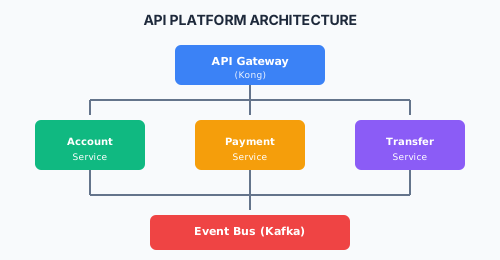
NUP Practices Applied
| Practice | Implementation | Result |
|---|---|---|
| Version Management | Semantic versioning for APIs | Clear upgrade paths |
| Branching Strategy | Git Flow with release branches | Stable releases |
| Security Training | Quarterly OWASP training | Zero security incidents |
| Health Checks | Comprehensive endpoint monitoring | 99.99% availability |
Key Metrics
| Metric | Target | Achieved |
|---|---|---|
| TPS | 10,000 | 15,000 |
| Latency (P99) | < 200ms | 85ms |
| Availability | 99.95% | 99.99% |
| Security Incidents | 0 | 0 |
| Developer Satisfaction | > 4.0 | 4.3/5 |
Related Resources
- RACI Example - Responsibility matrix
- V&V Plan Example - Verification plan
- Templates - Document templates
- Guidelines - Implementation guidance
Compliance
This section fulfills ISO 13485 requirements for management review (5.6), design and development records (4.2.4), and validation evidence (7.3.7), and ISO 27001 requirements for lessons learned (A.5.27), performance evaluation (9.1), and compliance with policies (A.5.36).