
This example demonstrates a Software Verification and Validation (V&V) Plan for a regulated software project. V&V plans are required by FDA QSR, IEC 62304, and other regulatory frameworks.
Document Control
| Attribute | Value |
|---|---|
| Document ID | VVP-001 |
| Version | 1.0 |
| Status | Draft |
| Author | QA Lead |
| Reviewer | Architect, Security Lead |
| Approver | Project Manager |
1. Introduction
1.1 Purpose
This Software Verification and Validation Plan defines the approach, activities, and responsibilities for verifying and validating the Patient Portal System to ensure it meets specified requirements and is fit for its intended use.
1.2 Scope
This plan covers:
- All software components of the Patient Portal System
- Integration with external systems (EHR, Identity Provider)
- Security and compliance verification
- Performance and reliability validation
1.3 Definitions
| Term | Definition |
|---|---|
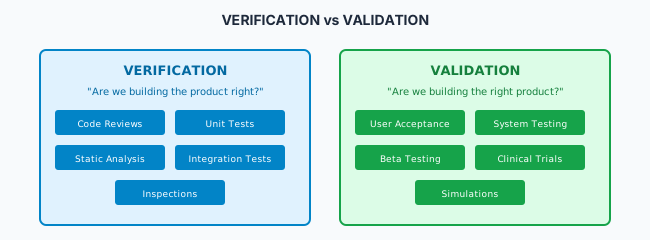
| Verification | Confirmation through examination and provision of objective evidence that specified requirements have been fulfilled |
| Validation | Confirmation through examination and provision of objective evidence that the requirements for a specific intended use are fulfilled |
| V&V | Verification and Validation |
| SRS | Software Requirements Specification |
| STR | Software Test Report |
2. V&V Overview
2.1 Verification vs Validation
2.2 V&V Activities by Phase
| Phase | Verification Activities | Validation Activities |
|---|---|---|
| Requirements | Requirements review, traceability analysis | Prototyping, user feedback |
| Design | Design review, architecture review | Interface validation |
| Implementation | Code review, unit testing, static analysis | Integration testing |
| Testing | Test review, coverage analysis | System testing, UAT |
| Deployment | Deployment verification | Operational validation |
3. Organization and Responsibilities
3.1 V&V Roles
| Role | Responsibilities |
|---|---|
| V&V Lead | Plan and coordinate V&V activities, report status |
| Test Lead | Design test strategy, manage test execution |
| Test Engineers | Execute tests, report results |
| Developers | Unit testing, support defect resolution |
| QA Manager | Approve V&V plan, review results |
| Project Manager | Resource allocation, schedule management |
3.2 Independence Requirements
┌─────────────────────────────────────────────────────────────────────────────┐
│                    V&V INDEPENDENCE LEVELS                                   │
├─────────────────────────────────────────────────────────────────────────────┤
│                                                                              │
│  Level 1: Developer Self-Testing                                             │
│  └─▶ Unit tests by developers                                               │
│                                                                              │
│  Level 2: Independent Testing Team                                           │
│  └─▶ System testing by separate QA team                                     │
│                                                                              │
│  Level 3: Independent V&V Organization                                       │
│  └─▶ Critical systems, third-party V&V                                      │
│                                                                              │
│  This project uses: Level 2 (Independent Testing Team)                      │
│                                                                              │
└─────────────────────────────────────────────────────────────────────────────┘
4. V&V Activities
4.1 Requirements Verification
| Activity | Description | Method | Responsible |
|---|---|---|---|
| Requirements Review | Review SRS for completeness, consistency | Inspection | V&V Lead, Architect |
| Traceability Analysis | Verify all requirements are traceable | Analysis | V&V Lead |
| Testability Review | Ensure requirements are testable | Review | Test Lead |
4.2 Design Verification
| Activity | Description | Method | Responsible |
|---|---|---|---|
| Design Review | Review architecture and design documents | Inspection | V&V Lead, Architect |
| Interface Analysis | Verify interface specifications | Analysis | Test Lead |
| Threat Model Review | Review security threat model | Review | Security Lead |
4.3 Implementation Verification
| Activity | Description | Method | Responsible |
|---|---|---|---|
| Code Review | Review all code changes | Peer Review | Developers |
| Static Analysis | Automated code scanning | Tool | CI/CD Pipeline |
| Unit Testing | Test individual components | Test | Developers |
| Code Coverage | Measure test coverage | Tool | CI/CD Pipeline |
Code Coverage Requirements:
| Metric | Target | Minimum |
|---|---|---|
| Line Coverage | 90% | 80% |
| Branch Coverage | 85% | 75% |
| Function Coverage | 95% | 90% |
4.4 Testing Activities
4.4.1 Test Levels
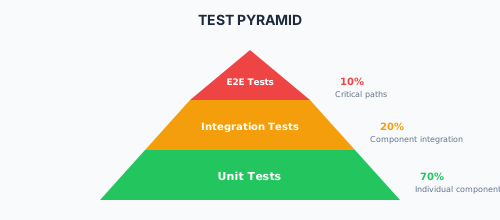
4.4.2 Test Types
| Test Type | Scope | Environment | Responsible |
|---|---|---|---|
| Unit | Components | Local/CI | Developers |
| Integration | Services | CI | Test Engineers |
| System | Full system | Staging | Test Engineers |
| Performance | Load/stress | Staging | Test Engineers |
| Security | Vulnerabilities | Staging | Security Team |
| UAT | User acceptance | Staging | Users/Product Owner |
4.5 Security Verification
| Activity | Method | Tool | Frequency |
|---|---|---|---|
| SAST | Static analysis | SonarQube | Every commit |
| Dependency Scan | SCA | Snyk | Every build |
| DAST | Dynamic scanning | OWASP ZAP | Weekly |
| Penetration Test | Manual testing | External vendor | Pre-release |
5. Traceability
5.1 Traceability Matrix
| Requirement | Design | Implementation | Test Case | Result |
|---|---|---|---|---|
| REQ-001 | ARCH-001 | MOD-001 | TC-001, TC-002 | Pass |
| REQ-002 | ARCH-002 | MOD-002 | TC-003 | Pass |
| REQ-003 | ARCH-002 | MOD-003 | TC-004, TC-005 | In Progress |
5.2 Traceability Requirements
- All requirements shall be traceable to test cases
- All test cases shall be traceable to requirements
- All defects shall be linked to requirements and test cases
- Coverage reports shall be generated for each release
6. Test Environment
6.1 Environments
| Environment | Purpose | Data |
|---|---|---|
| Local | Developer testing | Synthetic |
| CI | Automated testing | Synthetic |
| Staging | Integration/UAT | Anonymized production |
| Production | Live system | Real |
6.2 Test Data Management
test_data:
  synthetic:
    generator: Faker
    volume: 10,000 records
    refresh: Weekly

  anonymized:
    source: Production backup
    anonymization: K-anonymity (k=5)
    refresh: Monthly
    PHI_fields:
      - name: Randomized
      - ssn: Masked
      - dob: Shifted
      - address: Generalized
7. Defect Management
7.1 Defect Severity
| Severity | Description | Response Time |
|---|---|---|
| Critical | System unusable, data loss risk | 4 hours |
| High | Major feature broken | 24 hours |
| Medium | Feature impaired, workaround exists | 1 week |
| Low | Minor issue, cosmetic | Next release |
7.2 Defect Lifecycle
NEW ──▶ TRIAGED ──▶ IN PROGRESS ──▶ RESOLVED ──▶ VERIFIED ──▶ CLOSED
                         │                           │
                         └────── REOPENED ◀──────────┘
8. Entry and Exit Criteria
8.1 Test Phase Entry Criteria
| Phase | Entry Criteria |
|---|---|
| Unit Testing | Code complete, peer reviewed |
| Integration Testing | Unit tests pass (>80%), build successful |
| System Testing | Integration tests pass, staging deployed |
| UAT | System tests pass, release candidate ready |
8.2 Test Phase Exit Criteria
| Phase | Exit Criteria |
|---|---|
| Unit Testing | 80% coverage, all critical paths tested |
| Integration Testing | All integration points verified |
| System Testing | All test cases executed, no critical defects |
| UAT | User sign-off, acceptance criteria met |
9. Reporting
9.1 Status Reports
| Report | Frequency | Audience | Content |
|---|---|---|---|
| Daily | Daily | Team | Test execution status |
| Weekly | Weekly | Management | Progress, risks, issues |
| Phase | End of phase | Stakeholders | Phase summary, metrics |
| Final | Release | All | Complete V&V summary |
9.2 Metrics
| Metric | Target | Current |
|---|---|---|
| Test Case Pass Rate | >95% | - |
| Defect Detection Rate | N/A | - |
| Test Coverage | >90% | - |
| Defect Escape Rate | less than 5% | - |
10. Approvals
| Role | Name | Signature | Date |
|---|---|---|---|
| V&V Lead | |||
| QA Manager | |||
| Project Manager |
Related Resources
- QA Templates - Test documentation templates
- IEEE Standards - IEEE 829, 1012
- Checklists - Quality checklists
- Automated Testing - Testing strategies
Compliance
This section fulfills ISO 13485 requirements for design verification (7.3.6), design validation (7.3.7), and verification records (4.2.4), and ISO 27001 requirements for security testing (A.8.29), test information management (A.8.33), and secure development (A.8.25).