Continuous integration, delivery, and DevSecOps practices for regulated software
DevOps is a cultural and technical approach that combines development and operations teams to deliver software continuously, safely, and reliably. For regulated environments, DevOps practices must balance speed with compliance and quality requirements.
What is DevOps?
DevOps is the collaboration of development and operations teams, integrated processes, and tooling to deliver software-driven innovation continuously.
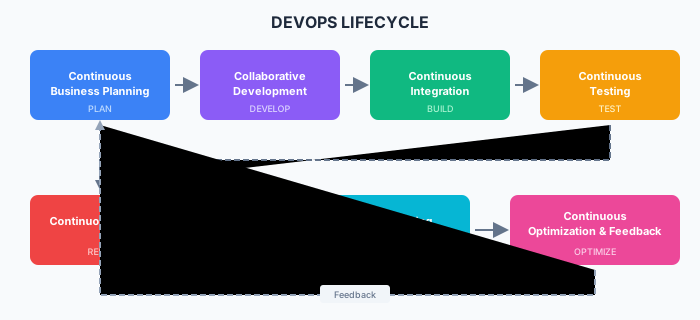
DevOps Lifecycle
DevOps Adoption Paths
The DevOps lifecycle consists of six adoption paths that allow teams to focus on immediate needs and grow from there:
Adoption Path
Focus Area
Key Activities
Continuous Business Planning
Plan & Measure
Lean principles, OKRs, adapt and learn
Collaborative Development
Develop & Test
Cross-team collaboration, CI, code reviews
Continuous Testing
Develop & Test
Automated testing, virtualized environments
Continuous Release & Deploy
Release & Deploy
Automated deployments, push-button releases
Continuous Monitoring
Monitor & Optimize
Performance tracking, availability monitoring
Continuous Optimization
Monitor & Optimize
Customer feedback, behavior analysis
DevOps Principles
Culture
Collaboration: Break down silos between Dev, Ops, Security, and QA
Shared Responsibility: Everyone owns quality and reliability
This section fulfills ISO 13485 requirements for software validation (4.1.5), design changes (7.3.7), control of production (7.5.1), control of records (4.2.4), and traceability (7.5.3), and ISO 27001 requirements for secure development lifecycle (A.8.25), environment separation (A.8.31), change management (A.8.32), configuration management (A.8.9), and secure architecture (A.8.27).